LA PASSIONE DI ALBERGATORI
dedicata ai nostri Clienti!
- HOTEL
- VIAREGGIO
- Hotel Vittoria ***
- Hotel Villa Morgana **
- Lido di Camaiore
- Hotel Sirena ***
- Hotel Valdinievole **
- Marina e Pietrasanta
- Hotel Ermione ****
- Hotel Esplanade ***
- Hotel Grand'Italia ***
- Hotel Nettuno ***
- Hotel Residence Villa Marzia ***
- FORTE DEI MARMI
- Hotel ***
- LAST MINUTES
- Special Last Minutes
- Where HOTEL are
- Hotels' Maps

Pistoia
30 km from Versilia
The history
The origin of the city of Pistoia is linked to the northward expansion of the Roman state, although one cannot exclude the possibility of previous settlements by other peoples such as the Etruscans, whose presence here is suggested by some archaeological artifacts found near the present day piazza del Duomo . At the beginning of the second century before Christ, when the Romans engaged in a bitter war against the Ligurian peoples in the Appenine hills, Pistoia was probably a fortified city (oppidum) that served as a supply post for the legions. lts name Pistoria, Pistoriae or Pistorium may be indicative of this role because pistoria in Latin denotes the oven used for baking bread.
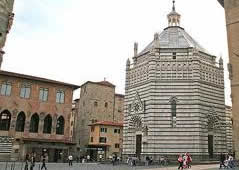
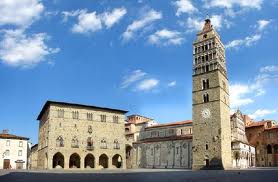
With the extension of the Cassia road as far as Lucca, Pistoia consolidated its importance in the territory even though the only notable event that involved the city was the defeat of Cataline and his followers in an undefined locality of the ager pistoriensis in January 62 B.C.. In the fifth century Pistoia became a bishopric and was brutally sacked by the Radagaiso Goths (405 B.C.), The later Lombard rule was important for the city which, because of its vicinity to the Byzantine border, took on a primary strategic role and became a gastaldato - a compartment ruled by a viceroy - that answered directly to the king. In this period Pistoia was surrounded by a city wall and the center of the city was organized around the curtis domini regis . Confirmation of the city's prominence can be seen in the authorization to mint a silver coin: the Pistoian tremisse. During the eighth century the important religious institutions (n.27/30/31) that had been built outside the city wall marked the direction of new urban development while in the next century the city's political life was organized around the bishop's court .Little is known about the domination of the Franks that followed Lombard rule nor of the Ottolingian period when Pistoia, too, was caught up in the development of the western world that was characterized by a closed economy and a feudal kind of political system.
The Guidi and Cadolingi Counts rivaled with the bishop for control over the city. The new millennium brought changes in the political institutions; in 1105 the city was ruled by consuls, the most ancient form of democratic rnagistracy, and in 1158 the podestà or governor curbed the power of the bishop who had built his fortified palazzo near the cathedral .
In 1177 the city passed its first statute, one of the oldest in Italy. During the eleventh and twelfth centuries, Pistoia distinguished itself for its strong economic growth; as a consequence the city carne to control a large territory that exceeded what is today the province of Pistoia.
In this period, perhaps its most glorious one, the city took on the Romanesque appearance that is still today its main characteristic and a new city wall was built. Civic life was disrupted, however, first by the struggles between opposing Guelf and Ghibelline factions and later between White and Black parties.
The thirteenth century was a moment of serious political crisis and Pistoia found itself caught between the two opposing powers of Florence and Lucca. There were many battles with these two cities; in the early fourteenth century the alliance of the two resulted in one of the most painful pages in the city's history: the siege of 1306.
Throughout the century, Pistoia tried to free itself but was placed under the rule first of Uguccione della Faggiola, Vinceguerra Panciatichi and Robert d'Anjou and then under Castruccio Castracani who ruled for Lucca, in mid century, just when it seemed like Pistoia was going to win back its autonomy, it entered the Fiorentine sphere of influence, having been seriously dirninished both demographically and economically by the disastrous plagues of 1 348 and 1400
In 1401 Pistoia lost its independence forever and became an integral part of the Fiorentine dominions. On September 10 of that year, after a true military incursion, some Florentine soldiers succeeded in gaining the City Hall; Florence put their own governor in office, thus wresting from Pistoia control over a large part of its surrounding lands. Even the diocese was subordinated to the one in Florence so that, from this moment on, the city's bishops would come mostly from the Tuscan capital. For the whole Medici era (fifteenth and sixteenth centuries) Pistoia did not make its own history although it was a key player in several noteworthy episodes.During the first half of the 1500s there was a continual flaring up of fighting between the factions led by the noble Cancellieri and Panciatichi families
It was this struggle to attain the few important political positions available that brought Machiavelli to the city in an attempt to shed light on these violent incidents. He convinced Florence to increase its power over Pistoia, thus undercutting any appearance of local autonomy.
In the following years, the city prospered, as can be seen in the many noble buildings that even today enhance the streets. Peace was maintained until 1643 when the Papal troops surrounded and besieged the city. The townspeople showed great courage in their resistance . In the sarne century Pistoia witnessed the ascendancy to the Papai throne of a representative of the clty aristocracy: Cardinai Giulio Rospigliosi who took the name of Clemente IX .
During the first half of the 1700s when the Grand Duke Giangascone, the last descendent of the Medici, died Tuscany passed under the rule of the Lorena family. Especially under the enlightened Pietro Leopoldo, Pistoia enjoyed a prosperous period. The modernization of the trans-Appenine roadways, with the road to Modena, restored to the city its central role in free trade with the North which had once been its oldest and primary activity.
At the end of the nineteenth century, all of Europe's attention turned to Pistoia for the diocesan synod summoned, in agreement with the Grand Duke, by Bishop Scipione de' Ricci, well-known for his Jansenist ideas of radical church reform. The people of Pistoia, just like Pope Pius VI, did not know what to make of this high prelate's innovative ideas and he was forced to leave the city a few years later .
At the end of the century Pistoia was occupied by French troops led by the young general Napoleon. The next year all of Tuscany was under French control. During Napoleonic rule Pistoia was included in the Area of the Arno and became a municipality governed by a French maire. With the Congress of Vienna and the restoration in Tuscany, the Lorenas returned and took up the program of reform initiated by Pietro Leopoldo. In 1851 the Maria Antonia railway arrived in Pistoia from Florence and in 1864, after the Unification of Italy, the Porrettana railway was completed.
Pistoia participated in the Risorgimento not only with the sacrifice of Attilio Frosini, Sergio Sacconi and Torello Biagioni, killed by the Austrians - not to mention the many others who fought for independence - but also through the philanthropy and art patronage of Niccolò Puccini
In 1848 the Grand Duke named Pistoia capital of a cornpartment and it was given a prefecture; just three years later it was degraded - as a punishment, it is said, for the city's pro-unification stance - to the level of sub-prefecture. From 1849 to 1855 the city was occupied by the Austrian troops that had been called to assist the Lorenas. In 1860 the citizens of Pistoia voted to join the kingdom of ltaly. Between the nineteenth and twentieth centuties Pistoia began to take on a more modern appearance as it underwent the process of industrialization; the San Giorgio company from Genoa built a factory here for the budding automobile industry. The city also promoted urban development even though the surrounding countryside remained prevalently agricultural
With the abolition of the city toll gates in 1909, the city walls lost all their significance and they were partially torn down Later, whole medieval sections would be demolished as a large part of the city changed its appearance.
During the Fascist period Pistoia was promoted to a provincial capital. During the Second World War, the city was a center of strong anti-German resistance and, especially in the countryside, the consequences of the harsh retaliations were badly felt. When the Partisans freed Pistoia on September 8, 1944 they found a very badly damaged city. With the reconstruction Pistoia has been transformed and today it is an important center for commerce and industry, linked to the Fiorentine metropolitan area and characterized by, among other things, a particular vocation for tree and plant producing nurseries.
www.comune.pistoia.it/eng/scoperta
The Zoological Gardens of Pistoia
( just out the center, is a big hill) were created on the initiative of Raffaello Galardini and inaugurated on April 19th 1970. The zoo is situated in the beautiful hills around Pistoia in a wooded area of 75,000m², and is the home of over 600 animals including about 65 species of mammals, 40 species of birds and 30 of reptiles. The majestic jaguar, the mighty polar bear, the agile Rothschild's giraffe, the enormous reticulated python and the rare Madagascan ring-tailed lemur are just some of the animals to be found in the zoo. New plans to make the zoo even more attractive and interesting will soon be underway: the management intends to make it a leading conservation centre for endangered species and for nature and environmental study. A day at the zoo is undoubtedly a unique opportunity to experience the animal world at close range.
Near Pistoia ther is a The park of COLLODI
EVERY YEAR IN THE CENTER OF PISTOIA
THE PISTOIA BLUES IN
A BIG EVENT (3 days) WITH FAMOUS ROCK STARS
10 Years of...
...di alberghiinversilia
Special Offer
All our special offers appositely for you! >>
Pubblicità
Spot