LA PASSIONE DI ALBERGATORI
dedicata ai nostri Clienti!
- HOTEL
- VIAREGGIO
- Hotel Vittoria ***
- Hotel Villa Morgana **
- Lido di Camaiore
- Hotel Sirena ***
- Hotel Valdinievole **
- Marina e Pietrasanta
- Hotel Ermione ****
- Hotel Esplanade ***
- Hotel Grand'Italia ***
- Hotel Nettuno ***
- Hotel Residence Villa Marzia ***
- FORTE DEI MARMI
- Hotel ***
- LAST MINUTES
- Special Last Minutes
- Where HOTEL are
- Hotels' Maps

SIENA
from Versilia 200 km
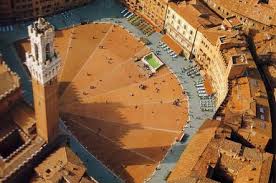
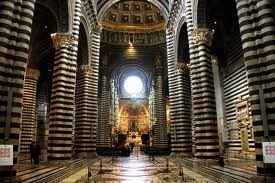
Situated 322 metres above sea level in the heart of Tuscany, Siena is built on three hills, maintaining intact its medieval appearance
characterized by narrow winding streets and noble buildings.Of Etruscan origin, it was a Roman colony with the name of "Sena Julia";
its importance grew in the Middle Ages, first as the seat of Lombard gastalds, and then of Counts under the Carolingian domination. After a long period of episcopal dominion (9th - 11th century) the town reached a peak of power after becoming a municipality (1147),
undertaking a policy of expansion towards the bordering territories.
Confrontation with Florence was inevitable and the struggle lasted, with various vicissitudes, until 1555, when after a long siege,
Siena was conquered by the Florentines, losing its autonomy and becoming part of the Duchy, sharing its fortunes until unification with Italy.
The site of Siena was originally an Etruscan settlement that later became the Roman city of Sena Julia. This colony disappeared, but the new Siena that later developed flourished under the Lombard kings. In the 12th century it became a self-governing commune.

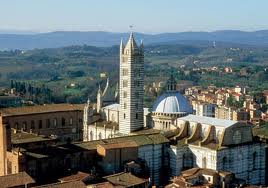
Economic rivalry and territorial conflict with neighboring Florence, which was anti-imperial, or Guelf, made Siena the center of pro-imperial Ghibellinism in Tuscany. The Sienese reached the peak of political success on September 4, 1260, when their army crushed the Florentine at the battle of Montaperti.
Siena became an important banking center in the 13th century but was unable to compete with its rival, Florence. The imperial cause declined, and the popes imposed economic sanctions against Siena's Ghibellines merchants. Soon afterward, Siena itself turned Guelf, and the Ghibelline nobility lost its share of power.
The city suffered from wars and famines and from the general economic decline that afflicted Italy in the early 14th century, and it was also devastated by outbreaks of the Black Death, which began in 1348. Siena endured between 1355 and 1559 the two most troubled centuries in its history: a long period of economic and demographic decline, of social conflict, and of increasing instability and tension in political life. Unstable régime followed unstable régime; in one disastrous year, 1368, the city's constitution was actually changed four times in an attempt to accommodate its contending power groups while, even more remarkably, the government structures of Siena were actually reformed ten times between 1525 and 1552.Externally this was also a period of incessant, purposeless and profitless warfare, although foreign warfare was less damaging to the economy than were the numerous visitations of marauding mercenary companies throughout the14th and 15th centuries.This was, in addition, a period in which the determination of the Florentines to conquer Siena became increasingly obvious.The Sienese attempted numerous solutions to their difficulties, and in 1399, despite the strength of the city's communal traditions, even resorted to the expedient of surrendering their city into the hand of Giangaleazzo Visconti of Milano. Visconti's rule of the city lasted until 1404. A more positive solution was the development of the system of government by a balia which, in Siena, became converted into a permanent magistracy and effectively replaced the traditional communal councils.
One feature of Siena's political life at this period has always provoked comment. This was the system of monti or ordini whose very existence seemed to institutionalize civic strife. Each member of the ruling èlite of Siena was a member of one of the city's five "monti", and each "monte" competed with the others for a monopoly of power in Siena. Attempts were made to devise some form of power sharing by which the monti could be brought to cooperate together, and these efforts were not always successful. Indeed, the periods of internal peace in Siena were ones when such coalitions worked well. This is the light in which we should see the period 1458-63, the pontificate of Pius II, when Siena effectively became a papal dependency. In 1487 an exiled aristocrat, Pandolfo Petrucci, Seized power and ruled with brutal tyranny through a period of French and Spanish invasions until his death in 1512. His régime was continued by his family until 1524. This so-called "signoria of the Petrucci" can best be understood as the most successful power-sharing exercise of the period, in which the Petrucci acted as peculiarly effective chairmen of the various coalitions by which Siena was governed.
In the early 16th century, as the economic decline of Siena accelerated, and the position of her ruling élite weakened in consequence, the successful creation of such coalitions became difficult. Siena was constantly torn by party strife and civic turmoil and this turbulence created a kind of political vacuum in the center of Italy from which the French hoped to profit.
Charles V was forced to respond to this French treat by taking an interest in the city, and in the 2nd quarter of the century Spanish influence in Siena became increasingly obvious. After 1530 a garrison of Spanish troops looked as if it would guarantee the city's loyalty, but to make certain Charles V decreed that a fortress should be built in Siena. This action forced the Sienese into open rebellion in 1552, and the Spanish were driven from the city.
With sporadic French assistance, the Sienese tried to preserve their independence for the next three years in what has become famous as an heroic struggle against the combined forces of Spain and Cosimo I de' Medici. But in 1555 Siena was starved into surrender, although fighting continued in the Sienese contado for another four years.
Siena was governed directly by the Spanish until 1557 when it was sold to Cosimo I de' Medici, whose possession of the city was confirmed by the Peace of Cateau-Chambrésis. After 1559, therefore, the history of Siena followed that of the Grand Duchy of Tuscany. In 1861 Siena, together with the rest of Tuscany, was absorbed into the new Kingdom of Italy.
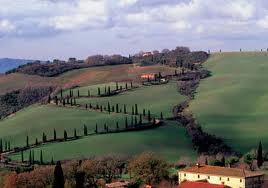
Although there is still some debate over the origins of Siena, is was most likely founded by Etruscans. Experts have different opinions on the exact origins of the Etruscans, but it is said that they migrated from the Aegeo-Asian area at the end of the 12th Century BC. The Etruscans were hilltop dwellers, and every hill had its own farmhouse just as we can still see today in the countryside around Siena.
The Etruscans had a most fascinating sub-terranean culture. Their belief in the afterlife, made it important to bury the dead with everything they might need for life after death. In Chiusi, a maze of underground tunnels is believed to have housed the mythical tomb of King Porsenna. Chiusi's underground tunnels contain an extraordinary storehouse of names bearing similarities with surnames still in use nowadays, and the Etruscan heritage is still found as an influence in the cuisine, and even in the DNA of the local population.
A sample group of residents of the town of MURLO have been tested for their genetic makeup, in order to find out possible genetic connections with their Etruscan forebears: comparison with the DNA extracted from bones from the tombs will definitely confirm if these people may still consider themselves "Etruscans".
The Chiusi Etruscan museum, and other Etruscans sites are within easy reach in the area around Siena, such as Chianti, Val di Merse and throughout the province in many museums.
san Galgano
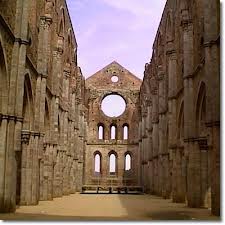
In the lands near Siena there are a lot of castels and abbeys san Galgano
castello di Brolio
castello di Meleto
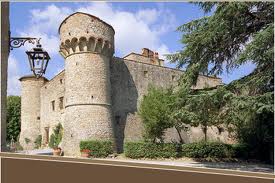
castello diSalci
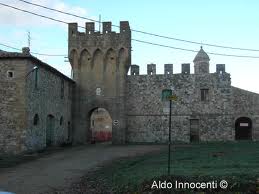
The famous Chianti wine is produced in Siena country hill
THE "PALIO RACES" OF SIENA
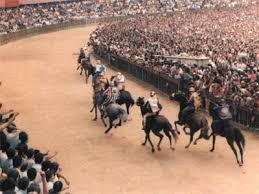
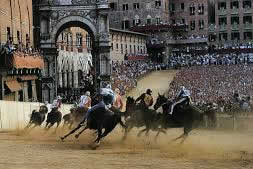
A race which lasts less than 2 minutes, is the subject of debate and competition all year round and can cause men and women to laugh or cry; such is the Palio, the greatest traditional festival in Siena.Siena is divided into seventeen contrade, or areas of the city. The Sienese people belong first to a contrada and then to the city. Each contrada competes against one another in the Palio, and rivalry and competition are an integral part of the preceding months before the event. Ten contrade are selected for each race, each contrada is assigned a horse, and the horses compete in la corsa of Piazza del Campo while thousands of people come as spectators and participants, transforming the main piazza into a teeming sea of people. There are two palio races each summer; one on the 2nd of July, and the second on the 16th August. The festivities start three days prior to each Palio, although the anticipation is already evident weeks before. During this time, there are banquets, parades, blessing of the horses and celebrations of all kinds. During these days, there are events such as the assigning of the horses to the ten contrade the first, second, third and fourth trial, and the Prova Generale, followed by the dinner of the Prova Generale for each contrada. Contrada colors are worn by Sienese people, and music, singing and drumming can be heard on the streets at all times of the day or night. On the day of the Palio, spectators crowd into the piazza from noon on, willing to bear sun, heat and sweat to witness this traditional event. The more sedate will pay for seats situated around the edge of the piazza, which are usually sold out eight months in advance.
The piazza is sealed off minutes before the Palio starts, and eventually (after a few false starts), the horses are off, and it is over before the dust settles. The winning contrada feasts and celebrates for weeks afterwards, with banquets, replays and much discussion, and the losing contrade can only hope that with much preparation, plotting and luck, they will fare better in the following race.
A wonder for all who see, this tradition is unusual in that it is of the people of the city - the Palio is a unique phenomenon, one that arouses much emotion, an event that the Sienese people hold dear to themselves, and as such is a strong authentic tradition that is a once in a lifetime experience to witness and enjoy.
from www.aboutsiena.com/palio-of-Siena.html
10 Years of...
...di alberghiinversilia
Special Offer
All our special offers appositely for you! >>
Pubblicità
Spot