|
LIVORNO 20 km from Versilia |
|||||||||||||
| to tuscanytravellers homepage | |||||||||||||
 Livorno was defined as an "ideal town" during the Italian
Renaissance. Today, it reveals its history through the
structure of its neighbourhoods, crossed by canals and surrounded by
fortified town walls, through the tangle of its streets, which embroider
the town's Venice district, and through the Medici Port
characteristically overlooked by towers and fortresses leading to the
town centre. Designed by the architect Bernardo Buontalenti at the end
of the 16th century, Livorno underwent a period of great town planning
expansion at the end of the 17th century.
During the Napoleonic
Wars, trade with England
was prohibited and the economy
of Livorno suffered greatly. Then, in 1868,
after Livorno became part of the new Kingdom
of Italy, she lost her, by now, traditional status of “Porto
Franco” and the city's importance declined.
Livorno was defined as an "ideal town" during the Italian
Renaissance. Today, it reveals its history through the
structure of its neighbourhoods, crossed by canals and surrounded by
fortified town walls, through the tangle of its streets, which embroider
the town's Venice district, and through the Medici Port
characteristically overlooked by towers and fortresses leading to the
town centre. Designed by the architect Bernardo Buontalenti at the end
of the 16th century, Livorno underwent a period of great town planning
expansion at the end of the 17th century.
During the Napoleonic
Wars, trade with England
was prohibited and the economy
of Livorno suffered greatly. Then, in 1868,
after Livorno became part of the new Kingdom
of Italy, she lost her, by now, traditional status of “Porto
Franco” and the city's importance declined.
Near the defensive pile of the Old Fortress, a new fortress, together with the town-walls and the system of navigable canals, was then built. In the late 1580s, Ferdinando I de Medici declared Livorno a "porto Franco", which meant that the goods traded here were duty free. The "Leggi Livornine" were laws which ruled between 1590 and 1603. These laws helped the trading activities of the merchant, freedom of religion and amnesty for some penance. Thanks to these laws, Livorno became a cosmopolitan city and one of the most important ports of the entire Mediterranean area
During the Napoleonic Wars, trade with England was prohibited and the economy of Livorno suffered greatly. Then, in 1868, after Livorno became part of the new Kingdom of Italy, she lost her, by now, traditional status of “Porto Franco” and the city's importance declined.
|

As in Venice is possible to have a tour in the channel to make a visit <under the city>,in the fishers laboratory
The Scama tour
Livorno is a water city. the MERCATO COPERTO (Covered Market), a building with wide windows, food products are sold inside;
|
Near Livorno
Part of Livorno province: member of the Arcipelago Toscano, in the Tyrrhenian Sea, between the Italian mainland and Corsica Elba island
Montecristo island Island of Capraia
Island Giglio |
|||||||||||

 Many foreigners moved to Livorno; Jews, Armenians,
Greeks, Dutch, and English were among those who relocated to live and
trade. Some Moriscos (Muslim Spaniards forcibly converted to Catholicism),
much later, also moved to Livorno (from Spain and during the 18th
century).
Many foreigners moved to Livorno; Jews, Armenians,
Greeks, Dutch, and English were among those who relocated to live and
trade. Some Moriscos (Muslim Spaniards forcibly converted to Catholicism),
much later, also moved to Livorno (from Spain and during the 18th
century).

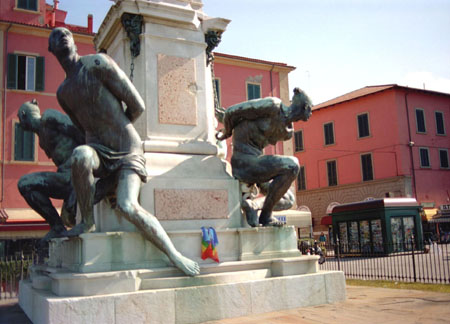


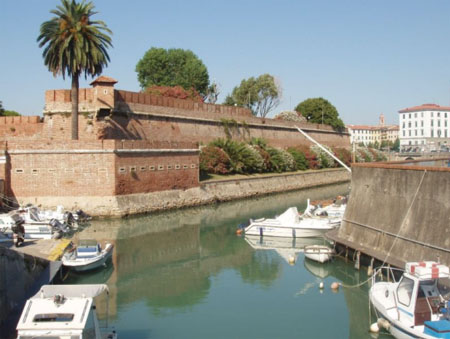

 castello Sonnino


