|
Elba
Island: History
|
| http://www.cosetoscane.com/html/news.html?codice=25&lang_sel=en |
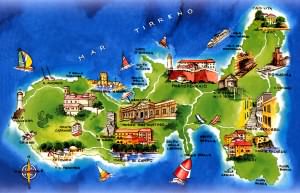 The
island was inhabited in ancient times by populations of Ligurian
stock, who first exploited its mineral seams during the early Iron
Age. Excavations and finds, however, point to the presence of man
here from paleolithic times.
The
island was inhabited in ancient times by populations of Ligurian
stock, who first exploited its mineral seams during the early Iron
Age. Excavations and finds, however, point to the presence of man
here from paleolithic times.In about the 10th century B.C., Greeks from Phocea settled on the island, drawn here by the abundance of ironores, which using rudimentary means, they smelted down on the site. From the Greek aitholos, spark, the island gained its first name (Aethana or Aethalia), an illusion to the sparks of the innumerable smelting furnaces that, due to their heavy consumption of wood, were to lead to the destruction of the island’s forestal patrimony. When the Etruscans and the Greeks from Syracuse moved in (in the 6th and 4th century, respectively), iron smelting was transferred to the mainland, in the territory of Populonia, where it continued throughout Roman times until the early centuries of the Empire. Under Roman domination, the island, taking the name of Ilva from the prevalence of Ligurians, known as Ilvates, acquired great economic and commercial importance, which lasted until the dearth of both island and coastal woodland made legislation necessary to prohibit lighting smelting furnaces. In reality, with the continued expansion of its dominions in Europe and Asia Rome had gained possession of rich ironore seams elsewhere, requiring less costly and more advantageous systems of working than those practised on Elba, which thenceforward entered a phase of rapid decline. At the fall of the Roman Empire Elba was unable to avert Longobardic invasion and came to be governed by a duchy based at Lucca. The name of Elba, replacing Ilva, first appears in a passage from Gregory the “Great’s Dialogues” (second half of the 6th century A.D.). At the end of Longobardic domination, Elba, which at the time of Sextus Pompeus had been a highly fortified, impregnable naval base, was left open to raids by Greek, Norman and Saracen pirates and was subjected to costant plundering. After a period under papal rule, Elba passed into the political sphere of Pisa. In the 11th century the island was invaded by the troops of Al-Mujahid, who after conquering the Balearics and Sardinia (1015), added Elba to his possessions and held until his defeat at Luni by the united fleets of Pisa and Genoa. To avert the costant threat from Saracen pirates, Pisa took steps to fortify a number of localities on the island, especially Marciana, Rio and Capoliveri, and also to rebuild the fortresses at Luceri and Volterraio, where, in earlier times, an Etruscan acropolis once stood. Pisan domination of Elba was never consolidated by reason of the continual attempts made by Genoa to take over the island, attracted by its strategic and commercial advantages position in the middle of the Tyrrhenian sea. After the battle of Meloria (1290), with its disastrous outcome for Pisa, he Genoese did in fact conquer Elba but after a mere two years had to yeld it up once more to the Pisans. |
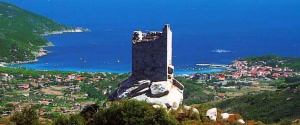 As the tide of events changed, in the process involving the island in the wars with Florence, in 1399, Elba was absorbed by the State of Piombino, founded by Gherardo Appiano, Lord of Pisa, who, subsequent to his sale of the town to Gian Galeazzo Visconti, nonetheless retained his seigneurial rights over Piombino, Suvereto, Buriano, Scarlino, Vignale, Populonia, Elba itself, Pianosa and Monte Cristo. Caught up in the rivalries between the various power and faced with the frequency of barbarian raids the Lords of Piombino had to steer a course fraught with difficulties to mantain their dominion, which was repeatedly threatened both by Siena and by Florence. Elba continued to be hotly contested by Genoa, which, in 1441, made a bid for take-over; in 1448 Alfonso of Aragon also attempted conquest. During the wars for predominance fought between France and Spain, the State of Piombino, notwithstanding its declared neutrality, was unable to avoid involvement. The island of Elba served French and Spanish troops in turn as a base for naval operations. In 1501, Cesare Borgia, known as “the Valentinois”, son of Pope Alexander VI, forced Giacomo IV Appiano into exile. Only on the death of the pope in 1503 did Appiano regain possession of his State. To consolidate his power, Giacomo IV formed an alliance with Ferdinand the Catholic, from whom he obtained the rank of captain in the Spanish army in the kingdom of Naples, entrusted with a contingent of troops and a fleet to defend his State. In 1509, to gain the addictional protection of Maximilian I of Hapsburg, he obtained elavation of the Seigneury of Piombino to the eminence of a principality, together with a formal declaration of its status as an Imperial fief, this recognition was later ratified by Rudolph II of Hapsburg. During the reign of Giacomo V, the coast and the Tuscan islands were subjected to countless barbarian raids, especially by Khair ad-din, known as “Barbarossa”, who had established his cove on the island of Palmaiola. Elba was repeatedly plundered and many of its inhabitants were deported as slaves; some of them later to be liberated by Charles V, when, as a reprisal, he attacked and destroyed Tunis. However, the danger of news raids remained and to counter the costant Saracen threat, in 1548, Charles V entrusted defence to Cosimo I de’ Medici, Duke of tuscany, granting him the fief of Piombino. This investiture, however, was revoked a year later in response to dual protest from the Duchess Regent Elena Appiano, mother of Giacomo VI, and from the Genoese. But the balance of power on Elba was nonetheless altered; the Medici retained the territory where Portoferraio would later stand, the Appiano family, the remainder of the island. On the ruins of the old townships of Fabricia and Ferraia a stronghold was built, formed of three forts linked by solid, powerful defence works. This was to have been named Cosimopoli, in honour of Cosimo, but, ultimately, took the less resounding name of Portoferraio. The Medicean defence walls proved highly efficacious when, in 1553, the Turks of Draghut, encouraged by France, attacked the island and devasted the islands of the Appiano family, while Portoferraio cam through unscathed. As Elba was a good base for fleets, the Spanish under the Viceroy of Naples, Juan Alfonso Pimentel Herrera, occupied Longone and established a permanent garrison there. Thus, from 1603, the island came under tripartite rule, shared between the Grand Duchy of Tuscany, the Appiano dynasty and Spain. This balance of political power was preserved until 1738, when with the Medicean dynasty extinct and the Polish war of succession resolved, by the Treaty of Vienna the whole of Elba was assigned to the Grand Duchy of Lorraine. Prior to this event, after the Appiano line became extinct, the Emperor had sold the principality of Piombino, in 1734, to Niccolò Ludovisi, husband of Polissena Appiano, and, in 1735, Longone and the Stato dei Presidi had been absorbed by the Bourbon kingdom of Neaples. With the cession of Corsica to France in 1768, the English brought pressure to bear on Peter Leopold to purchase Elba, but the Bourbons and France opposed this move. |
 In 1796, under the pretext of protecting the 4000 French royalists who had taken shelter at Portoferraio two years earlier, the English reacted to republican occupation of Livorno (Leghorn) by disembarking on Elba. The unsettled situation that resulted from the incessant skirmishes between France, England, the Bourbons and the Lorrainese was only righted in 1802, when, by the Peace Treaty of Amiens, Elba was annexed to France. The French administrative system was introduced on the island, whose circumscription included also the islands of Capraia, Pianosa, Palmaiola and Monte Cristo. Taken as whole, French rule brought such beneits as improved road network, reactivated trade and considerably improved economy to the island. The new fiscal system and the introduction of land tax, however, led to serious unbalance and discontent, especially among small landowners and, in general, among all those who derived no benefit from sea trade. In the Capoliveri area, above all, dislike of the French led to frequent uprisings, which were bloodily suppressed. By the Treaty of Fontainbleau (11 April 1814), Elba, together with Pianosa and Palmaiola, came to constitute an indipendent kingdom and was assigned to Napoleon, who stayed on the island from 3 May 1814 to 26 Frebuary 1815. During Napoleon’s brief reign, not only did the island’s economic conditions remain unchanged but neither did the planned administrative reforms take place. Although he tried to reactivate trade and resuscitate the mining industry, the need for money forced him to expropriate the income from the mines and increase land taxes; this made the proud inhabitants of Capoliveri hostile; they rebelled the sovereign’s greed and whose resistance was only broken by the threat of weapons. To facilitate communications between the island’s most important strategic points, Napoleon ordered a series of road improvements, opening the road to Pontolongone and constructing a new road to Lacona; he fostered the modernization of agriculture and the development of fishing, with the creation of tunny-fishing nets. Above all he took great care to make his military garrison and small fleet as efficient as possible. He made an effort to gain the affection of the local bourgeoisie, softening them with honorary titles and invitations to his court, where he had imposed a pompous and complicated etiquette. After Napoleon’s brief reign, the island returned to the Grand Duchy of Tuscany and thereafter to the Kingdom of Italy in 1860. However, unification marked the dawn of a new economic era for Elba. The entry into the union of a large modern state, with the inevitable tax and administrative recognition, led to the fatal loss of those benefits which the Grand Duchy government had granted to the island’s population, to lift them out of the despair they found themselves in after the French domination and Napoleon’s brief reign. The four mainstays of Elba’s economy, which had been the collection of salt, grape-growing, sailing and ironore mining, entered a state of crisis towards the end of the century. The salt works ceased their activities; an epidemic of philoxera caused the destruction of the vines; the application of steam machines on ships supplanted sailing. Elba’s economy focused all its energies on the exploitation of ferrous minerals and the iron and steel industry. Portoferraio, with its blast furnaces, built between 1900 and 1902, became an industrial centre of national importance. However, in 1947, the iron and steel works, which had been damaged by bombing during the Second World War, were deemed anti-economical and their dismantling was decreed. The island then fell into a state of terrible depression, from which it recovered fairly rapidly, thanks to the discovery and exploitation of its potential as a tourist spot. Source: “The Elba Island” |